Phonics for Kindergarten

Phonics for kindergarten students goes smoothly when a few basic principles are followed. Keep things clear and simple, and your young learners will progress rapidly. I'll share a few specific principles here, and give you plenty of ways to practice them at the bottom of the page!
Note: This is a spelling site, but good phonics skills form an important foundation for reading, spelling and learning success!
Basic Phonics Principles for Early Learners
Here's a peek at the printable version of our guidelines. The full text also appears below.
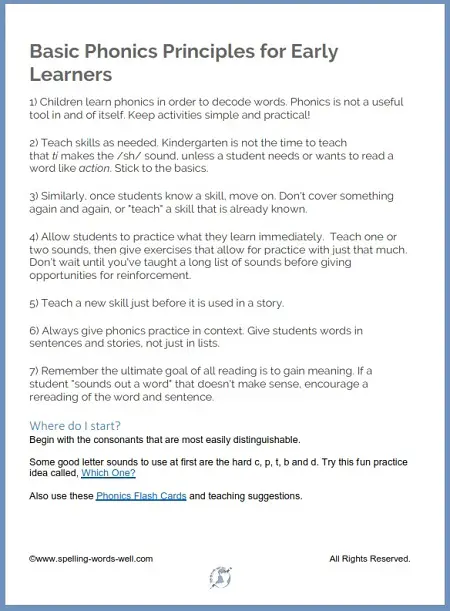
1) Children learn phonics in order to decode words. Phonics is not a useful tool in and of itself. Keep activities simple and practical!
2) Teach skills as needed. Kindergarten is not the time to teach that ti makes the /sh/ sound, unless a student needs or wants to read a word like action. Stick to the basics.
3) Similarly, once students know a skill, move on. Don't cover something again and again, or "teach" a skill that is already known.
Where Do I Start?
Begin with the consonants that are most easily distinguishable.
Some good letter sounds to use at first are the hard c, p, t, b, and d. Try this fun practice idea called Which One?
Also use these Phonics Flash cards and teaching suggestions.
4) Allow students to practice what they learn immediately. Teach one or two sounds, then give exercises that allow for practice with just that much. Don't wait until you've taught a long list of sounds before giving opportunities for reinforcement.
5) Teach a new skill just before it is used in a story.
6) Always give phonics practice in context. Give students words in sentences and stories, not just in lists.
7) Remember the ultimate goal of all reading is to gain meaning. If a student "sounds out a word" that doesn't make sense, encourage a rereading of the word and sentence.

Fun Activities with Phonics for Kindergarten Students:

ABC Phonics Poem
- A fun and funny way
to learn about initial sounds!
Alphabet Phonics Booklet
- Students customize their own pages in this A to Z phonics activity.
Fun Preschool Phonics Games - 3 simple adaptations of familiar formats with a phonics twist.
Letter Lane - A phomenic awareness board game that features beginning consonant sounds for the letters b,d,f and m. No reading is necessary.
Phonics Printables - 2 super-simple worksheets for beginners, featuring the letters b, c, d, f, g, and h as initial consonants
Rhyme Time Two cute printables to give early learners practice in identifying rhyming words with short and long vowel sounds.
To E or not to E? -
Easy activities to reinforce the important skill of using a silent e at
the end of a word
Tic-Tac-Toe
and What's Right? - Two very
easy-to-implement ways to practice primary phonics
skills
Phonics for kindergarten can be fun, using a wide variety of learning activities. Check out these links for even more ideas:
Sign Up Here for My Free Newsletter
- Spelling Words Well ›
- Phonics Activities ›
- Kindergarten
Subscribe or Read the Latest Updates Here


-
Phonics Printables - Free, Fun & Fast to Prepare!
Oct 05, 26 02:55 PM
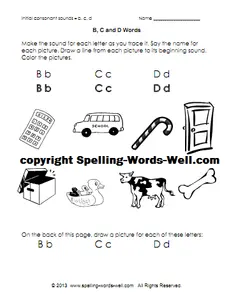 Use these fun, free phonics printables to teach and reinforce beginning consonant sounds. On these pages, students match pictures to their first letters.
 -
300 Sixth Grade Spelling Words
Oct 05, 26 02:43 PM
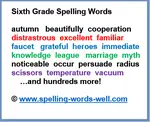 Mastery of these sixth grade spelling words will help your students succeed. Free pdf list for home or classroom use. Links to more 6th grade words & activities.
 -
Spelling Words Well
Oct 05, 26 02:41 PM
 Spelling Words Well offers free PDF spelling word lists, vocabulary words, spelling worksheets, games, spelling bee words, word brain teasers, phonics, & more.